
Anaphylaxis and food allergy: What every Australian needs to know
Australia holds the dubious honour of one of the highest food allergy rates in the world. Almost 2 million Australians now tread carefully around the dinner plate and thousands of them call South Australia home.

Here's the number that should stop you in your tracks: anaphylaxis presentations to emergency departments have risen 51% in just five years, to more than 11,500 per year. That's not a slight trend for Adelaide's emergency departments, that's an escalation affecting real families in our community.
Whether you're a parent, a childcare director, a footy coach or someone who loves hosting a barbie, knowing how to recognise anaphylaxis and respond quickly could save a life. And no, you don't need to be a medical professional. You just need to know what to look for and what to do next.
So let's get into it.
The growing crisis: Adelaide's food allergy reality
The growing rate of food allergy in Australia isn't just a headline. It's the colleague who carries an EpiPen in her handbag. The kid at the birthday party who can't have the cake. The parent who calls ahead every time they book a restaurant.
Let's educate ourselves about the realities of anaphylaxis, understand how EpiPens work, ask the right questions about food safety and be the kind of community member who brings more than just awareness but genuine understanding and life-saving knowledge too.
Because when it comes to food allergies in South Australia, ignorance isn't bliss. It's a risk our communities can't afford.
What is anaphylaxis and why is it so serious?
Anaphylaxis is the most severe form of allergic reaction. It's a full body emergency that can affect breathing, the heart, the airways and blood pressure, often all at once and very quickly.
Here's why it's dangerous. Once the immune system is sensitised to an allergen (a food, insect venom, drug, or other substance), a subsequent exposure can trigger a massive release of histamine and other inflammatory chemicals. This can cause the airways to swell, blood pressure to drop and, without treatment, can be fatal.
The Australasian Society of Clinical Immunology and Allergy (ASCIA) defines anaphylaxis as:
“Any acute onset illness with typical skin features (urticarial rash or erythema/flushing, and/or angioedema), plus involvement of respiratory and/or cardiovascular and/or persistent severe gastrointestinal symptoms; or
Any acute onset of hypotension or bronchospasm or upper airway obstruction where anaphylaxis is considered possible, even if typical skin features are not present.”
Anaphylaxis can occur without any prior warning reaction. Someone can have mild reactions their whole life and then have a severe one or have anaphylaxis on what seems like a first exposure. That's what makes awareness so important.
What triggers anaphylaxis?
Most common triggers
Anaphylaxis triggers break down as follows:
Most Common Triggers:
Foods - 62% of all anaphylaxis cases
Medications (drugs) - 12% of cases
Insects - 8% of cases
Less Common Triggers:
Latex exposure
Exercise (with or without food consumption)
Cold temperature exposure
Immunisation (rare occurrence)
Idiopathic (unidentified cause)
The 9 foods behind most allergic reactions

Whilst technically any food can trigger an allergic reaction, around 90% of reactions in Australia come from just nine foods:
Peanuts
Tree nuts (cashews, almonds, walnuts, etc.)
Egg
Cow's milk
Wheat
Fish
Shellfish
Soy
Sesame
Peanuts, tree nuts and shellfish are among the most common causes of fatal anaphylaxis in Australia. Reactions to these foods are more likely to persist into adulthood than allergies to milk or egg, which often resolve in young children.
One important myth to bust here. Touching or smelling an allergenic food is unlikely to trigger anaphylaxis. To cause anaphylaxis, the food allergen generally needs to be ingested. However, even very small amounts, as little as 0.5mg of protein for some people, can be enough in highly sensitive individuals.
Signs of a mild or moderate allergic reaction
Not every allergic reaction is anaphylaxis. Mild to moderate symptoms include:
Swelling of the lips, face or eyes
Hives or welts
Tingling mouth
Abdominal pain or vomiting (note: for insect allergy, these are actually severe symptoms)
These symptoms need to be taken seriously and watched closely. A mild reaction can progress to anaphylaxis sometimes without any intermediate warning.
Signs of anaphylaxis
Anaphylaxis can develop within minutes. According to the ASCIA Action Plan for Anaphylaxis, watch for any one of the following:
Difficult or noisy breathing
Swelling of the tongue
Swelling or tightness in the throat
Difficulty talking or a hoarse voice
Wheeze or persistent cough
Persistent dizziness or collapse
Pale and floppy (in young children)
Skin symptoms like hives may not always appear before anaphylaxis sets in. In one in six cases of fatal food-induced anaphylaxis, severe cardiovascular symptoms developed with no skin symptoms at all. Don't wait for a rash to act.
Some people also experience anxiety, confusion or a "sense of impending doom" — which sounds dramatic but is a real neurological symptom that should not be dismissed.
Early signs in infants and toddlers can also be subtle — sudden lethargy, unusual clinginess, drooling or irritability all warrant close attention.

Anaphylaxis first aid
This is the section that matters most.
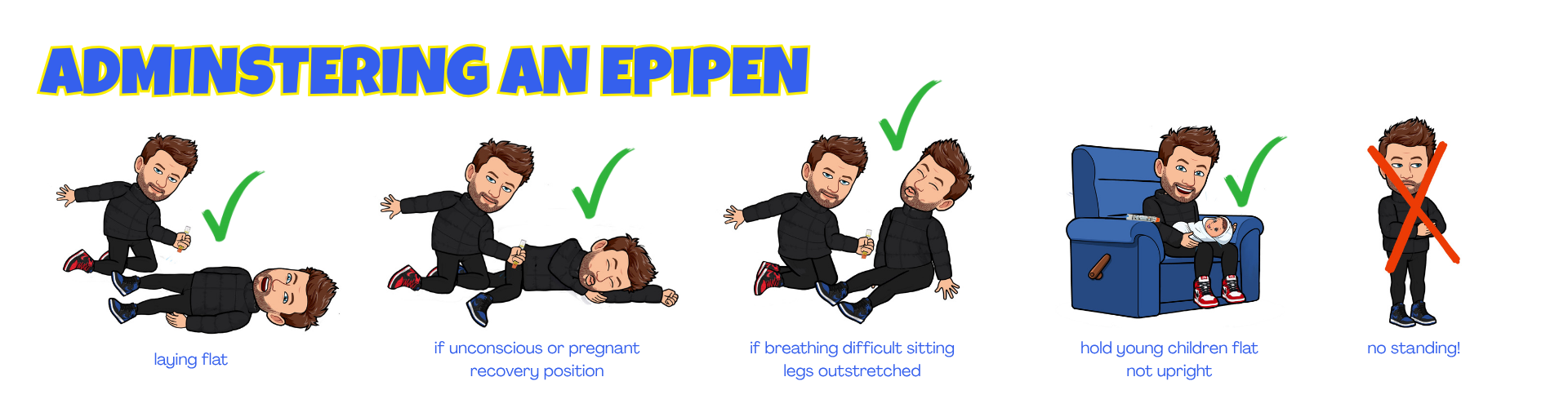
1. Lay the person flat, don't let them stand or walk
Position is critical. Standing or walking during anaphylaxis can cause a fatal drop in blood pressure within seconds. Lay the person flat. If they are having difficulty breathing, allow them to sit upright but keep them as still as possible and be ready to lay them back down. Hold young children flat, not upright.
If the person is unconscious or pregnant, place them on their side in the recovery position.
2. Give adrenaline (epinephrine)
If the person has a prescribed adrenaline auto-injector (such as an EpiPen®), use it immediately into the outer mid-thigh.
3. Call 000 immediately
Call an ambulance even if symptoms appear to improve after adrenaline. The effects of adrenaline last only around 15–20 minutes and symptoms can return. The person needs hospital observation for at least 4 hours after symptoms resolve.
4. Give a second dose if needed
If symptoms don't improve within 5 minutes, a second dose of adrenaline can be given if a second device is available.
5. Give asthma medication if respiratory symptoms are present
Give it after adrenaline, not instead of it.
6. If they become unresponsive and stop breathing normally, start CPR
Follow DRSABCD until the ambulance arrives.
What NOT to do:
❌ Don't give antihistamines as a substitute for adrenaline. They don't treat the life-threatening symptoms
❌ Don't allow the person to stand up or walk
❌ Don't give food or drink during the reaction
❌ Don't delay calling 000 waiting to see how they go
Know what you have to do before you need to
The confronting reality about anaphylaxis is that it's fast. We're not talking about a gentle escalation you have 20 minutes to Google. We're talking about minutes, sometimes less.
The people who respond best are the people who've already thought about it. Who know what they're looking for. Who've held a trainer EpiPen and know exactly where it goes and how hard to push.
That's exactly the kind of confidence we build at Engage First Aid. Our nationally accredited courses cover anaphylaxis management in a way that's memorable, practical and engaging. Because the best training is the training that sticks.
Book your first aid course or anaphylaxis course in Adelaide with Engage First Aid.
Learn more about food allergy safety
For more information about food allergies and anaphylaxis:
Sources
ASCIA
The Australian Resuscitation Council
Allergy & Anaphylaxis Australia
Peters et al. (2017, 2024). Food allergy prevalence in Australian children
Drewett, Encena, Gregory, Franklin & Trubiano (2022). Anaphylaxis presentations to Victorian hospital emergency departments
The information provided in this blog offers general insights only. The content is not intended to serve as medical advice and if you are experiencing a medical emergency, please call 000 immediately.